
“Kill your darlings,” they say. “Hold them under the icy waters of pragmatism, stiffen your arm against their thrashing, and watch the light of their potential slip away into the current.”
They actually only say the first part, and even then only in writing circles, but the feeling is about right and the advice is unfortunately solid. To “kill a darling” refers to taking some beloved piece of your story, one which you’ve built your whole story around, and, if required, removing it completely because the story would be better off without it.
The Matter of Being has already had to drown a few darlings, and I’ve learned some unintuitive lessons along the way. The most interesting among them? Sometimes ignoring your playtesters is the move.
Let’s get into it.

Darling-in-Chief: Completing a Pact
In The Matter of Being you play a spirit facing divine punishment, or something like it. To escape the fate that awaits you in the Mansus, you rely on summoners to keep you bound to the mortal world where your terrible fate can’t follow you. This sets up a really straightforward game loop: you get a quest from a summoner, you manipulate the game board to satisfy the quest, and then you get a reward. Along the way, you try to set it up so that someone else wants to summon you next, so you continuously have a reason to stay in the mortal world.
Fail to do that, and you’ll return to whence you came to be fed to a worm, cast into nowhere, or whatever it is that happens to spirits who misbehave.
All well and good.
The darling was this: I figured that if a pact with a mortal was what kept you in the world, then completing your pact meant the deal was concluded and that it no longer provided you weeks in the mortal world. Completing a pact too early was therefore not to be encouraged! I had an entire model of gameplay that revolved around the player trying to delay finishing their quests, and making sure they had another quest lined up before turning in their current one.
I took this idea, excitedly, into my first playtest, which had several quests ready to go. And then it blew up spectacularly.
The Thing About Quests…
The thing about quests as a video game conceit is that, broadly speaking, we want to do them. So what happened in my first playtest was that people got their first pact with Mohammed, figured out how to cure Mohammed of his cancer, happily hit “commit”…
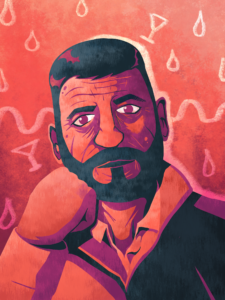
And watched their “weeks remaining” drop to 0. People thought it was a bug, or that they had done something wrong, or that maybe they weren’t supposed to cure Mohammed at all. Nothing stopped players from immediately picking up a new quest to get more weeks, but the strong negative feedback didn’t compel them to go looking the way I hoped. Most players bounced, and didn’t get to the rest of the content at all.
So that didn’t work, and what happened next might well have sank the game: I asked playtesters how to make this whole “losing your weeks” mechanic better. And I got plenty of well-intentioned feedback! Tutorial popups, warning popups, UI feedback – the works!
Fortunately for the project, I ignored it.
“Double or Half It”
I had decided to ignore my playtesters before I heard this bit of advice (from a Skeleton Songs episode, actually), but the advice goes like this: If you’re balancing something, try doubling its impact, or else halving it. Gauging the impact of tiny tweaks is often quite hard, and you might have to iterate a whole lot to get where you need to go.
I wasn’t facing a balance issue, but my system was obviously broken. What would it look like if the system just…wasn’t there?
What if someone could summon you, give you five weeks to do a quest, and if you solved the quest on the first week, well hey, you got four “free” weeks out of the deal. I didn’t like that as much from a purely narrative angle, but I implemented on my next playtest, featuring new players, and lo and behold: almost nobody bounced, and most players made it to the end of the existing content.
And at the end of the day, wasn’t the premise basically intact? If you failed to convince people to summon you in those weeks, you would lose the game for the reason I wanted you to anyway. Easier to balance the game around players having ‘extra’ weeks than try to teach them to almost, but not quite, finish their quests.

The Deal with Playtester Feedback
This whole little saga (and another one like it) taught me a funky thing about player feedback, though, which is that people’s desire to be helpful can work to your detriment. If you ask someone, “hey, how do I fix system X?” It probably feels pretty unhelpful for them to say “actually I hate system X and I think you should hurl it from a cliff.” They want to compromise with you to meet your original vision, and by focusing on the mechanics they dislike, you’ve also sort of primed them to assume the existence of those mechanics in the first place.
Since then, I’ve acquired a few questions I really like to ask my playtesters. Stuff like:
“What things did you wish you could do in the game that you couldn’t actually do?”
“If this were your dream game, and we had a million dollars, how would this game play?”
You might not be able to, or even want to implement everything they say, but I found it really useful for remembering what players even found fun about my game in the first place. In this case, I forgot that in a narrative game, content can be its own reward. It’s easy to be self deprecating as the person writing the game, and assume that nobody will care about or read what I’ve written, so I had fallen into this fixation on tricky little mechanics that might “make up” for the fact I was making players read so many gosh darned words.
When I asked questions like this, however, I found that all my players basically wanted to contentmax, and any mechanics that detracted from contentmaxxing or the possibility of contentmaxxing was going to frustrate them. So that was nice: they wanted me to keep writing! And if I had kept my questions focused on the mechanics themselves, I probably would have forgotten that little detail.
If you’re a developer and want to share some things that have really helped your playtests, I’d love to hear from you! And if you want to share any hidden narrative gems that you think TMOB could borrow from, I’m all ears for that too.
You know where to find me.
(And if you aren’t following our Kickstarter yet, our “followers” page is the only metric we have! If this project interests you, please do.)